
The most common conditions which affect the hand and wrist are listed below. Learn more about the classic symptoms associated with these diagnoses. Visit a hand specialist to learn more about your condition and treatment options. Here is a hand and wrist symptom checker.
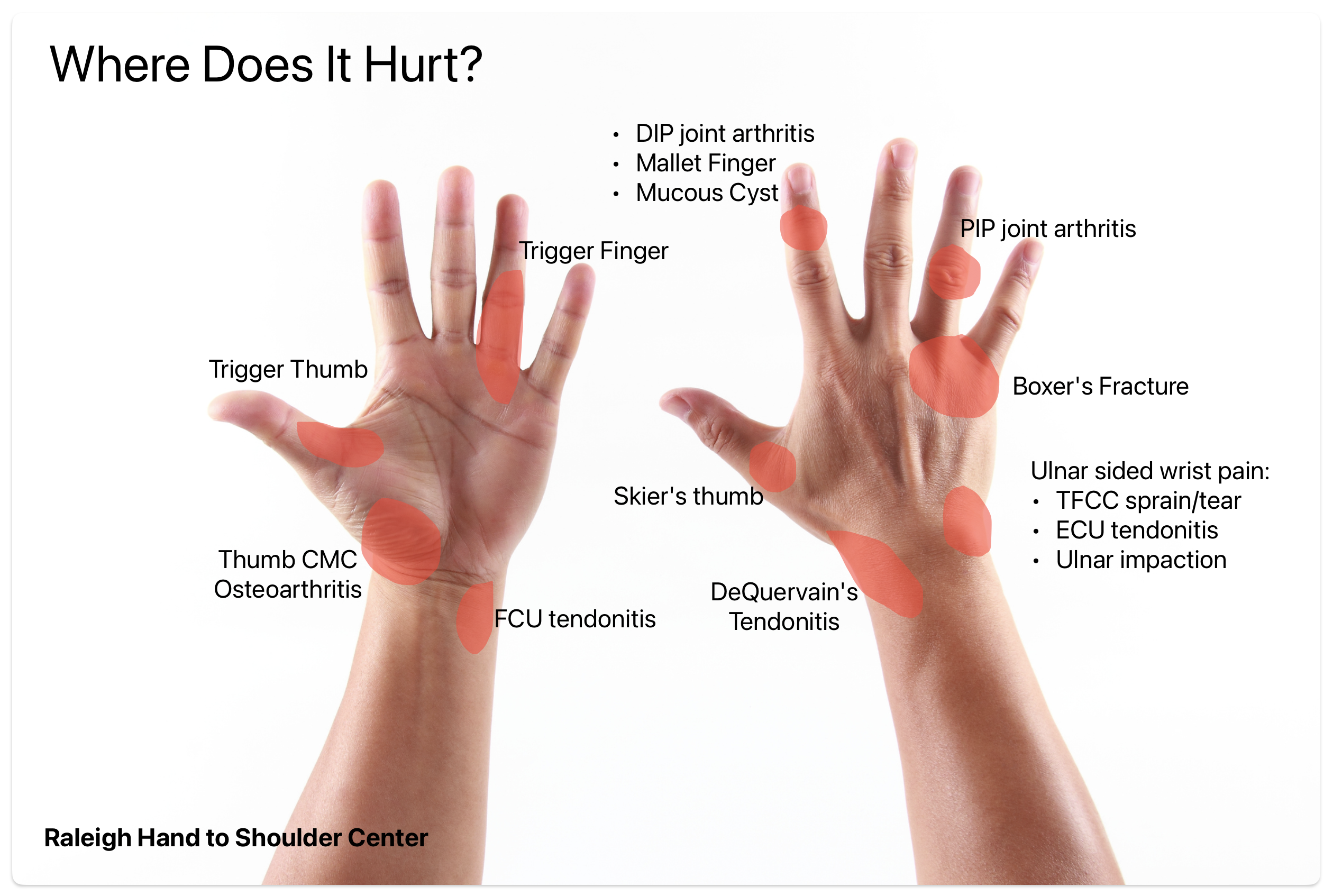
Hand Conditions
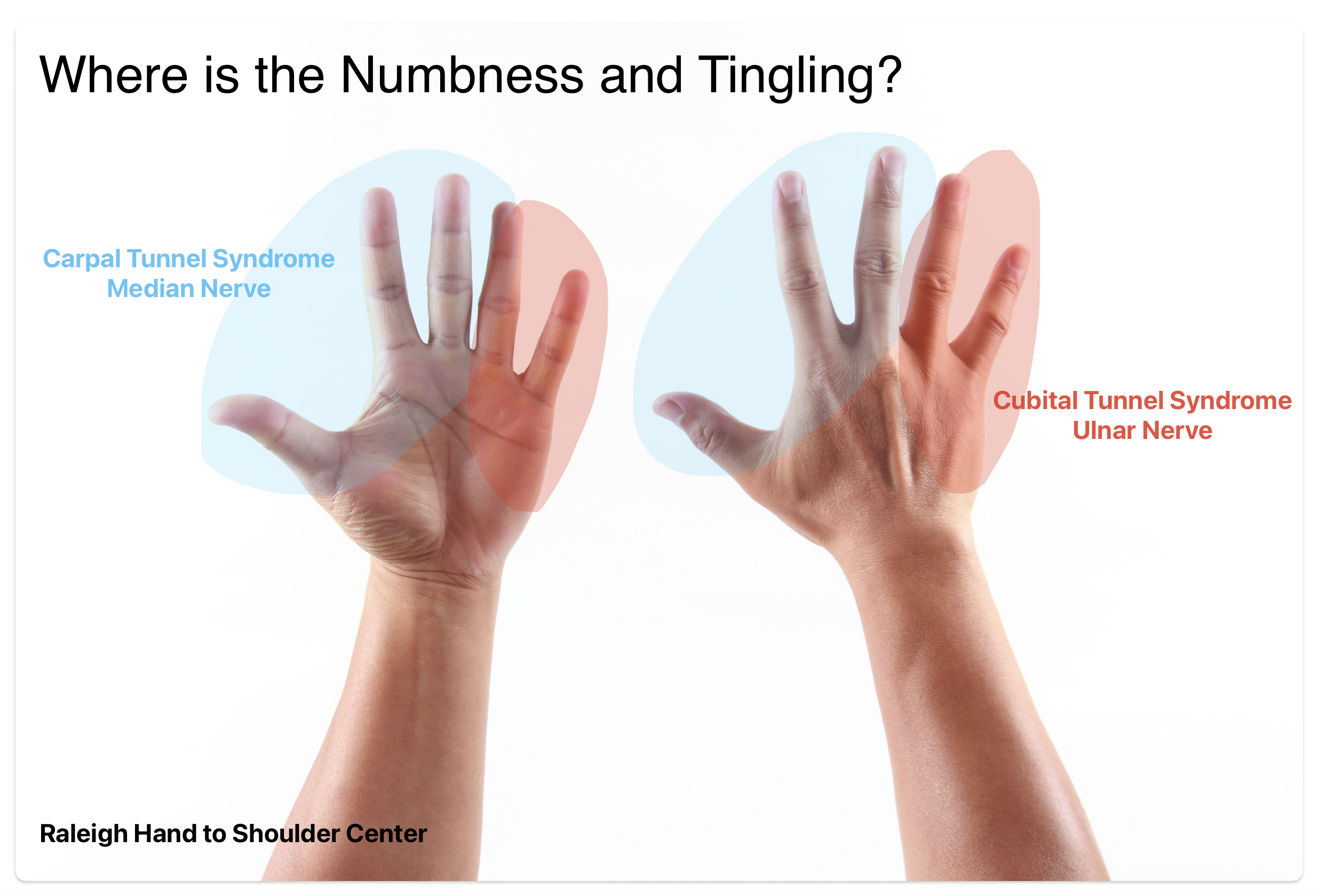
Carpal tunnel syndrome: Numbness and tingling in the thumb, index and middle fingers. The pinky finger is not typically numb in this condition. Symptoms can come and go during the day at first. Numbness and nerve pain in the hand can awaken patients at night during sleep. Over time the hand numbness can become constant and patients have difficulty with holding things with the hand. The hand may become swollen and the thumb muscles can become weak. More common in patients over 40 years of age, with increasing prevalence with age.
Cubital tunnel syndrome: Numbness and tingling in the pinky and ring fingers. Symptoms can come and go, related to an activity when the elbow is flexed more than 90 degrees. In some cases the finger numbness is constant, all the time. The small muscles in the hand can become weak and this may affect the dexterity of the hand. Patients can have difficulty with fine motor skills such as buttoning a shirt, typing on the computer, or playing an instrument. The condition is related to a pinched nerve at the elbow, which affects the hand function.
Trigger Finger: The fingers will click or pop when the patient makes a fist. Occasionally the finger will get stuck or lock in flexion when the fist is made. Trigger finger is usually painful when the finger gets stuck in this position. Sometimes this condition leads to finger swelling, stiffness, and limited range of motion. Trigger finger is more common in women and diabetic patients. Trigger thumb is a similar condition causing painful locking or popping in the thumb.
Dupuytren’s contracture: In early cases there is a build up of firm nodules in the palm. Patients may later develop linear cords in the palms going into the fingers. Over time, the fingers can gradually become fixed in a bent position and unable to be fully straightened. Dupuytren’s contracture is not usually painful. Patients have difficulty shaking hands, reaching into a pocket, or putting on gloves. Also known as Viking’s disease and most common in men over age 50 with Northern European ancestry. This condition is more prevalent in some families.
Thumb CMC joint arthritis: Pain at the base of the thumb within the large muscle belly of the thumb. Often worse with pinching tasks such as opening jars or crocheting. Occasionally the thumb joint can look swollen, deformed, or crooked. Some patients notice gradual weakness with the hand and can begin to drop things. In most cases the thumb pain is gradual in onset with a dull ache. Occasionally the pain is very sharp and severe. This condition is more common in women over age 50.
Mucous cyst: The usual appearance is a round bump filled with clear fluid in the finger. These cysts can look like a small blister in some cases. They are located near the finger joint closest to the fingernail. These can be sore if they are bumped. Occasionally they are red, swollen, and tender. If the cyst is popped and drains fluid, it often grows back over time. They can become infected if they are drained at home and bacteria get inside. Often associated with osteoarthritis in the joint and more common in patients over age 50.
Mallet finger: Drooping of the fingertip downward after a direct injury to the end of the finger. Patients cannot fully straighten the finger on their own, but the finger can be pushed upward and straight with the other hand. Often swollen and tender at the finger joint closest to the fingertip. Common in sports such as basketball and baseball. This condition is a result of a tendon injury or finger fracture.
Skier’s Thumb: Pain and swelling in the thumb after an injury which forcibly bent the thumb backwards. Pinching tasks such as writing and opening jars are difficult due to pain and weakness in the thumb. Some patients notice instability in the thumb joint and weakness/pain with pinch. Common injury among skiers who fall with the hand on their ski pole. Also common in sports injuries.
Boxer’s fracture: Pain, swelling, and deformity in the hand after punching a hard object, such as a wall. This occurs on the pinky side of the hand. Limited finger range of motion, hand bruising, and the appearance that the 5th knuckle is out of place. Most common in young adult males.
Wrist Conditions
DeQuervain’s tendonitis: Pain on the thumb side of the wrist, often with swelling in this area. Certain movements of the thumb and wrist can feel sharp and excruciating. Some patients notice painful popping of the wrist tendons. More common in women and very common in postpartum women. Also known as mommy’s wrist.
Ganglion Cyst: A ganglion cyst often appears to be a round, fluid filled bump in the wrist. Can be various shapes and sizes. The most common location is the back of the wrist. Occasionally the cyst is firm, tender, and causes pain with doing push ups, yoga, or planks. Sometimes the cyst is large, rubbery and not painful at all. The second most common location is in the palm side of the wrist at the base of the thumb. These cysts can occur at any age in males and females. Also known as Bible cysts.
TFCC sprain: Pain on the pinky side of the wrist, which can begin after a wrist injury or after repetitive twisting motions. Gripping and twisting with the hand, such as turning a doorknob or screwdriver, can increase the wrist pain. Painful clicking and popping in this area can occur. Common condition in patients who play racquet sports and golf. This is a common cause of ulnar sided wrist pain.
Scaphoid Fracture: Pain on the thumb side of the wrist which begins after an injury to the wrist. Most patients do not recognize the fracture at first and assume it is “just a sprain.” Most common in young males after a fall on an outstretched hand. Bruising and swelling are not always present in this injury. Patients have limited wrist range of motion and pain with weight bearing. Common in young, active males.
Distal radius fracture: Pain, bruising and swelling in the wrist after an injury. The wrist may look crooked and swollen with limited mobility. Pain can be severe and patients have trouble making a fist. Common in young adults related to trauma such as a motor vehicle injury or in older adults after a fall from standing height. More prevalent in patients with osteoporosis, particularly postmenopausal women.
Scapholunate Ligament Injury: Pain in the center of the wrist after a hard fall on an outstretched hand or a sports injury. Occasionally associated with swelling as well as limited wrist mobility. Weakened grip and clicking in the wrist are common. This can also occur in patients over age 50 from everyday “wear and tear” which may result in wrist arthritis.
Disclaimer: The information on this website is intended for general information only, and it does not constitute medical advice. This educational material does not replace an evaluation by a qualified medical professional. Please make an appointment with a physician if you have concerns.